

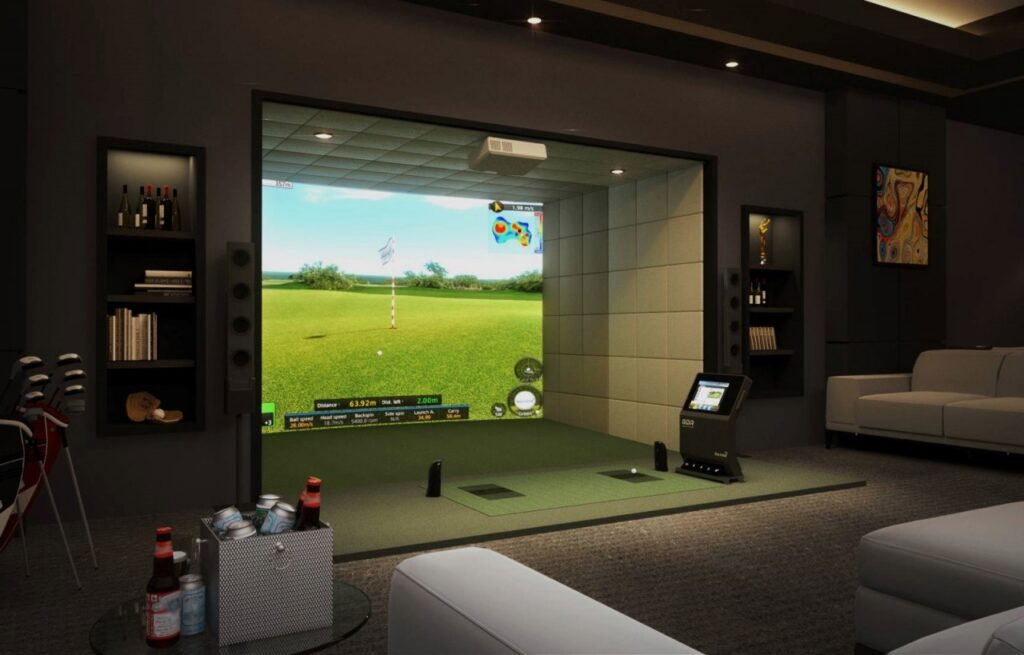
For many golfers, the sport is more than a pastime. It’s a year-round commitment. But weather conditions, limited daylight, or access to a local course can make consistent practice difficult. This is why golf simulators have become increasingly popular for residential use. With a properly built simulator, you can practice full-swing shots indoors without worrying about weather, course availability, or travel time. However, one critical aspect of building an indoor simulator is often overlooked: impact safety. In an enclosed space, an uncontrolled ball rebound has the potential to cause serious injury or property damage, making proper wall padding essential. Here are our tips for using memory foam for golf simulators.
Understanding Rebound Risk in Enclosed Golf Simulator Spaces
In an outdoor environment, the open space absorbs most of a golf ball’s energy. Indoors, that energy has nowhere to go. When a ball strikes a rigid surface—such as drywall, concrete, or paneling—the impact typically results in a fast, unpredictable ricochet. Even with netting, certain areas of the enclosure remain vulnerable. A poorly padded simulator bay can allow a golf ball to bounce back toward the player at high velocity, creating a major safety hazard.
This is why the wall materials you choose are just as important as the simulator hardware itself. Proper padding must diffuse the force of impact, prevent rebound, and maintain long-term performance despite repeated contact.
Why Most Foam Types Aren’t Suitable for Golf Simulators
Although foam is the foundation of a safe simulator enclosure, not all foams behave the same way under impact. Most common materials fall into one of two categories:
- Closed-cell foams (such as polyethylene)
This material is dense, rigid, and designed for structural support or shock absorption—not ball-stopping applications. Its stiffness can actually increase rebound speed, making it unsuitable for impact surfaces directly behind the ball. - Traditional open-cell foams (such as standard polyurethane)
While more compressible than closed-cell varieties, conventional open-cell foams still exhibit elastic rebound. When a golf ball strikes the surface, the foam can compress and spring back quickly, causing the ball to ricochet.
Because both categories contain materials engineered for durability and load support, they aren’t optimized for controlled energy absorption.
Why 3 lb Memory Foam Is the Ideal Simulator Wall Padding
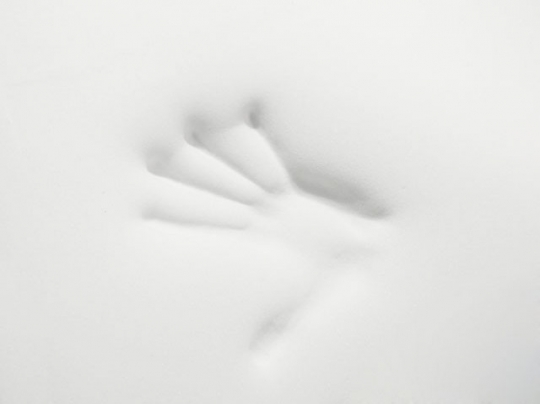
The most effective solution for minimizing bounce-back is a material that compresses deeply under force, disperses the ball’s kinetic energy, and returns to form slowly. This is exactly how 3 lb Memory Foam, such as our 3LB Memory Foam Mattress Topper, behaves. Memory foam is engineered to contour around applied pressure rather than push back against it. On a mattress, this translates to body-conforming comfort; in a golf simulator, it results in a surface that “captures” the ball at impact.
When a ball hits 3 lb memory foam:
- The foam deforms gradually, allowing the ball to sink into the surface.
- Impact energy is dispersed throughout the foam rather than reflected back.
- The material rebounds slowly, preventing the elastic snap-back that causes ricochets.
The result is a dramatic reduction in bounce-back—often eliminating it entirely when installed correctly.
Best Practices for Installing Memory Foam in a Golf Simulator
For effective protection, placement and coverage are important. While every simulator layout is different, we generally recommend:
- Padding the entire back wall, since this is the primary impact zone.
- Covering the side walls, especially the wall corresponding to your swing direction.
- Using full-height panels rather than small segments, increasing both safety coverage and aesthetic appearance.
To enhance durability, many users choose to upholster their foam panels with a strong covering such as vinyl or canvas. This protects the foam from repeated friction, prolongs its usable lifespan, and provides a smooth surface that integrates cleanly into your simulator design.
Build a Safer, More Reliable Simulator With Foam Factory
Once your foam panels are installed and your simulator components are in place, you’ll be able to enjoy an at-home golf experience that is both accessible and safe. We supply 3 lb Memory Foam specifically suited for impact-absorbing applications like golf simulator padding, offering consistent performance, reliable energy dispersion, and easy custom-cut options for DIY enclosures.
If you have questions about sizing, installation, or choosing the right foam for your setup, our team is always ready to help. Visit our Contact Us page to get expert guidance for your project.



Hey I’m wondering how you would apply the memory foam to drywall behind the golf sim screen. Thank you
The most efficient way to do this would be to put the 3lb Memory Foam Topper on wood, and then anchor the wood to the wall behind the screen. If you have further questions, please feel free to Contact Us.
I am looking for something for my ceiling to absorb golf balls in my golf simulator. Do you sell foam sections wrapped in black fabric? I see on your website a picture of a simulator with 2 x 2 foam squares in a lighter color fabric. Thanks
Please Contact Usfor further information regarding your inquiry.
what is the best application method to install on wood as mentioned above?
We would typically suggest adhering the foam to the wood using a Spray Adhesive, and then anchoring those to the wall.
Hello, if yor anchor the memory foam to the wall behing the screen, how much space should we leave between the screen and the memory foam?. How thick do you recomendar the memory foam to be? Thanks
2-4 inches suggested airspace and 3-4 inches of 3LB memory foam is suggested.