

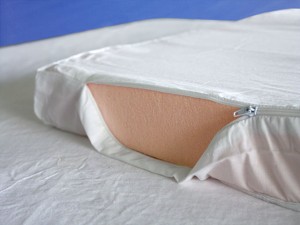
Memory foam’s most distinctive feature is its memory foam temperature sensitivity, which allows the material to conform precisely to the body for a customized sleeping or seating experience. Engineered with viscoelastic polymers that respond to both body heat and pressure, memory foam softens and molds uniquely to each user every time it is used. This adaptive behavior applies to mattresses, toppers, pillows, bolsters, and other comfort products, delivering consistent support and pressure relief while adjusting dynamically to the individual’s shape and weight.
How Memory Foam Responds to Temperature
Memory foam is engineered to be responsive to both ambient room temperature and body heat. The material’s viscosity—the degree to which it resists flow or deformation—varies depending on environmental conditions. In warmer rooms, memory foam becomes more pliable and fluid-like, which allows it to contour quickly to the body. Conversely, in cooler environments, the foam becomes firmer and more rigid, initially feeling harder until it gradually warms with body contact. This behavior is normal and reflects the material’s design, rather than any defect or quality issue.
Seasonal temperature changes can further influence memory foam performance. For example, memory foam mattresses or toppers may feel noticeably firmer in winter when home heating is lower, while in summer, the same product softens more rapidly. Despite these variations, memory foam consistently provides a pressure-relieving, cloud-like surface once it has adjusted to body heat, ensuring comfort across different conditions.
Temperature Retention and Sleep Warmth
Another factor to consider is that memory foam retains some of the heat generated by your body. This insulation can make memory foam sleep warmer than other materials, such as latex, polyfoam, or air mattresses. While the material does not act as a heating device, sleepers may notice a subtle increase in warmth, which can be particularly comforting during cooler months. The level of warmth experienced will also depend on the covering fabric, mattress protector, or topper encasement used.
The insulating quality of memory foam can enhance comfort in colder climates by maintaining a cozy, body-conforming surface. As the foam softens around the body, more surface area comes into contact with the material, helping to retain warmth while supporting pressure-free alignment.
Differentiating Memory Foam from Traditional Materials
Memory foam is often mistaken for latex foam or standard polyurethane foam due to its appearance and texture. Unlike these materials, however, memory foam exhibits dynamic response characteristics, adapting to both heat and pressure rather than providing static support. Understanding this distinction is important for managing expectations, particularly for new users who may be accustomed to conventional cushions or mattress materials.
Expect variations in feel and responsiveness depending on temperature and initial use, but rest assured that this behavior is a normal aspect of the material’s performance. With time, memory foam consistently delivers the supportive and pressure-relieving benefits that have made it one of the most popular materials in bedding and comfort products.
Getting the Most from Your Memory Foam Product
While memory foam is not ideal for everyone, its combination of contouring support and thermal responsiveness provides significant benefits for millions of sleepers worldwide. To maximize comfort and longevity, it helps to understand how temperature affects its behavior. By allowing the material to adjust naturally to your body heat, users can enjoy a surface that provides customized support, spinal alignment, and pressure relief, all while retaining subtle warmth during cooler periods.
Ultimately, memory foam’s unique properties make it a versatile and effective solution for a wide range of bedding products. By anticipating how the material responds to environmental conditions and body heat, users can make informed decisions and experience the full comfort and performance benefits that memory foam offers.



Can hot water bottles be used with memory foam for fomentation of back of persons with disc prolapse.
Yes you may use hot water bottles with our memory foam. Make sure the water does not leak into the foam, otherwise the cover will need to be removed and the foam will need to be air dried.
Will a memory foam mattress tolerate being in a cabin that has no heat all winter long in Michigan?
will freezing affect the mattress quality
Manufacturer states the foam will be OK for temperatures as low as -40 degrees F.
Will the memory foam be okay stored in an area that reaches high temperatures (like 120 deg F)?
Yes, the foam can handle temperatures that high with no negative impacts.
Hi, i ironed a shirt over a memory Foam mattress and now i feel that área softer. Did i ruin It? Thx
You should be OK. Memory foam gets softer with heat normally. Foam in general can handle temperatures under 200F and short bursts under 400F.
I bought a plush memory foam mattress from a dealer in Virginia. It feels firm and nothing like the showroom model which was plush and soft. I suspect a cold delivery truck for this problem. Anyhow, it’s not comfortable fir me to sleep on. What’s the best way to quickly soften the mattress? Should I heat it with an electric blanket? Thank you.
Most memory foam toppers are heat sensitive. After about 1 day the softness should return to normal. Also, with continuous use you should be able to ‘break in’ the memory foam topper as well. Hope this helps.
Is memory foam an option to insulate pipes against freezing? How might it’s properties function in this role?
Typically you would want to use a closed cell foam like polyethylene foam or neoprene foam for insulation.
There is no damage to the quality of the foam with low temperature.
Is there big difference how the foam fells in terms of firmness and comfort in a 22-24°room v.s a 15-20°C room?
What’s the highest temperatures a Memory Foam mattress can sustain & not get ruined, I stay where it gets very hot to 35 degrees Celsius _.
It most cases memory foam in a colder room will feel much firmer at first. Then as the temperature rises with the user, the foam will get softer.
Anything under 140F / 60C will be OK.
I was thinking of using a 3″ Dunlop perforated latex topper as a mattress in a vehicle mounted roof top tent. I live in Phoenix. Is this a suitable application for a latex mattress, or will the heat destroy it? What’s the max temp latex foam can handle?
The latex foam we carry is a very heavy foam. Furthermore, I do not think the latex foam will not be able to handle the heat.
Is it safe to use an electrically heated mattress pad over memory foam or latex foam mattress toppers? Also, could that shorten the life of the topper?
Yes, it should be ok. Make sure there is no exposed wiring and that the heated mattresses pad is in good condition – not worn or damaged. Using the heat pad should not impact the life span of the foam.
I want to move my Tempurpedic mattress across the country. Temperatures are sometimes running 115 degrees outside so a moving van will be hotter. What happens if the mattress is exposed to temperatures well above 150 degrees for up to 4 days?
The foam should be OK. Once the foam is exposed to temperatures above 180F for extended periods of time, the foam starts to degrade more quickly, leading to shorter lifespan for the foam.
My memory form bed has been exposed to 120+ degrees for 30 days. How does this affect the mattress? Will it still be ok or should it be replaced?
The foam should still be OK.
The memory foam bed is for a camper for a tight spot. The camper will not have air conditioning while expansion is that okay.
Yes, this should be OK.
Can a memory foam mattress be left in a camper during temperatures during winter storage without damage?
Yes, this should be OK.
Can I leave a foam mattress (unopened in the original box) in a car overnight with temps above 100?
Yes, that should be OK.
Will the latex mattress feel soFt when I sleep on it in a room with temperatures in the 50 degree range
Our Latex is a foam with a medium feel. The temperature should not effect how this foam will feel.
I find that when I first lie down for the evening, my mattress has good lower back support. However, through the night it heats up, and softens to a point where it no longer supports my lower back. I wake up with back pain every day. It’s been too long for me to return it. Any suggestions for ways to reduce it’s tendency to lose support?
Please Contact Us for further assistance.
Can it be stored unopened in box for 2 or3 months ? And at what temp.? I live in central Alberta, Canada.
We do not recommend keeping any foam product unopened at initial delivery for longer than 2 weeks. Any longer than that can cause the foam to deform permanently. For temperature, the manufacturer states that the foam should be okay in temperatures as low -40 degrees Fahrenheit.
Can you use a heated mattress pad with a memory foam mattress?
Yes, this is possible. Please make sure the heated pad does not have any frayed or damaged wiring before use.
We’re considering using Polyethylene foam for insulation to a building. Would this be a good choice, or what would you recommend?
Typically what is used for building insulation is polystyrene foam.
Can memory foam be compression molded as part of a fabric/foam composite? Curious if preheating of the materials as part of that process causes material breakdown. Or if heat resistance prevents the foam from holding the mold shape once it’s been released from the mold.
We do not recommend heating, cooling, or molding memory foam. Since it is memory foam, it will likely try to come back to the original size.
I live in phoenix. Will memory foam be ok in our travel trailer when not in use during the summer with temps well over 100 outside?
Our Memory Foamis not specifically tested for these circumstances. Heat will soften the foam when in use. If constantly in the heat, it may shorten the lifespan of the foam, but not significantly. Contact Usfor more information.
I keep my bedroom cold in wintertime..50 degrees and I like a heating blanket to heat my bed,so it’s warm when I get in,then I shut it off..I just bought a tempur foam topper for my bed.can I still use my heating blanket to get my bed warm?
This can vary depending on the brand of memory foam that you have. Our Memory Foamwould be okay to use a heated blanket on, however, you would not want to leave it on constantly. What will happen is that the heat will cause the memory foam to soften and become more easily contoured.